


Vaibhav Suryavanshi's Unique Power Hitting Advantage


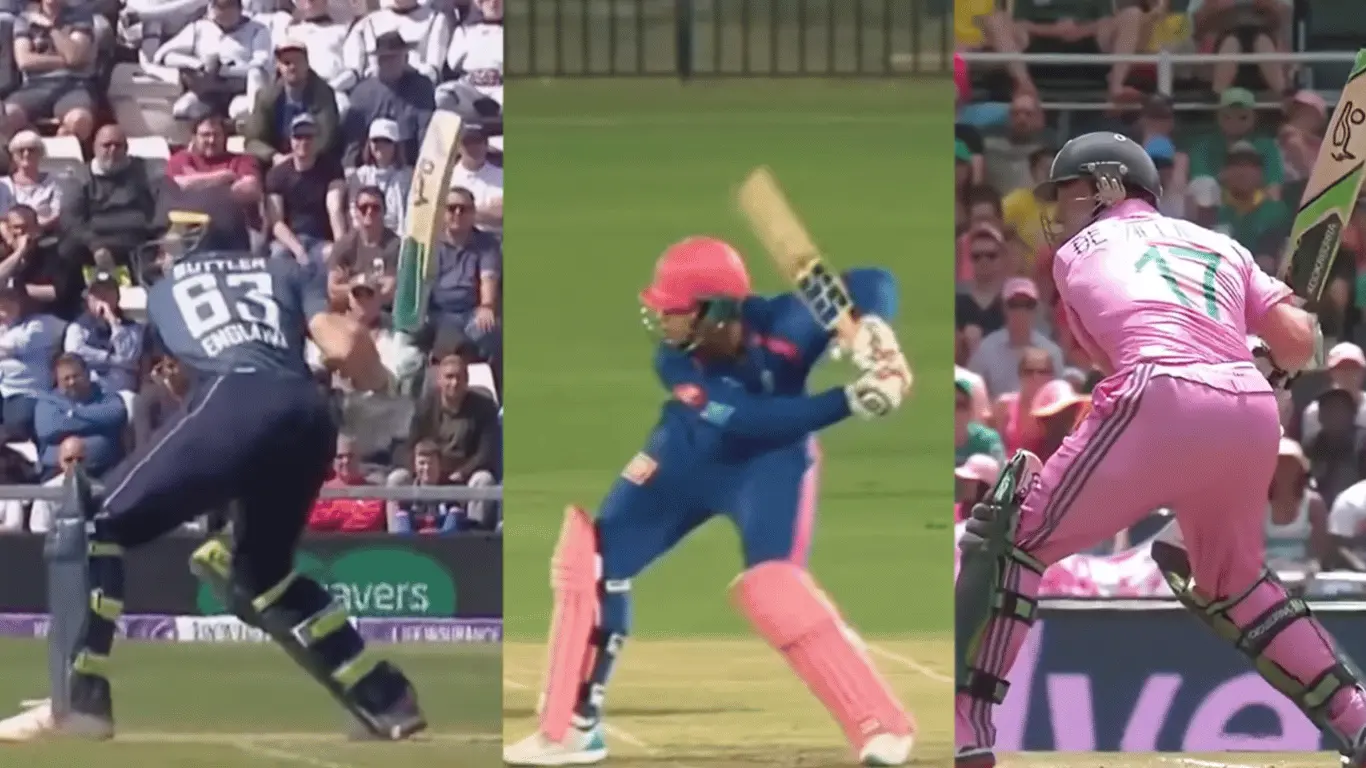
Vaibhav Suryavanshi has taken the cricket world by storm, and despite his age he has an advantage that most coaches are not talking about. The thing that lets him hit the ball so far is not just bat speed or hand-eye, though he has both. It is the position his bat starts from. He gets the bat past vertical and almost behind his head, with his back elbow high, in a way that even legends like AB de Villiers and Jos Buttler simply do not. That position gives him a longer lever, a longer path to accelerate the bat, and more potential bat speed at impact.
In this article we will run through the basic science of bat speed, look at what Suryavanshi shares with two of the greatest six hitters of the modern era, then explain the unique part of his swing. We will finish with the gym work that lets a regular cricketer get closer to the kind of power he produces, even if you are never going to copy his exact technique.
The science behind bat speed
Bat speed comes from a sequence, not from one thing. The kinetic chain runs from the floor up through the legs, the hips, the torso, the shoulders, the elbow and finally the wrist. Each link adds speed to the next, so the bat is moving as fast as possible at the moment of contact.
Peploe et al. (2019) tested this in a range hitting study and found three technique factors explained around 78 per cent of the difference in maximum bat speed between players. The first was X factor, which is the separation between the pelvis and the upper torso at the start of the downswing. The second was lead elbow extension on the way through the ball. The third was wrist uncocking, the late snap that finishes the swing. Those three sit at the centre of every elite power hitting action.
X factor is the big one. Picture a bird's eye view of the batter just before the ball is released. The shoulders are pointing straight down the wicket or even towards mid off. The hips are pointing towards mid on or mid wicket. The angle between those two lines stores energy through the trunk like winding up a spring, and the bigger the spring, the more energy you can release.
Elbow extension is the top arm punching through the ball. The lead elbow is bent at the top of the swing and straight at contact. The triceps do the work.
Wrist uncocking is the very last piece. The wrists are cocked at the top of the swing, then they snap through right before contact. They cannot save a bad sequence but they can finish a good one. Get those three right, middle the ball, hit it at around forty five degrees, and the ball goes miles.
What Suryavanshi shares with Buttler and de Villiers
Look at a freeze frame of Suryavanshi, Jos Buttler and AB de Villiers at the same point of the swing and you see three different players doing the same big things. All three create huge X factor. Front shoulder pointing towards the bowler, hips already opening towards mid on. All three brace through the front leg and use it as a pivot. All three drive the back hip through the ball. All three extend the top arm at impact. All three snap the wrists late.
If you are a cricketer who wants to hit it further, this is where you start. They are not glamorous, but they are the difference between a clearing the ropes and getting caught on the boundary.
The bit that is actually unique
The eye catching part of his technique is what happens with the bat itself. Look at Buttler in the same freeze frame and his bat is sitting almost dead vertical. AB de Villiers is similar with the toe of the bat pointing at the sky.
Suryavanshi is different. From the same angle his bat is fully past the vertical. It is almost behind his head. The toe of the bat is pointing back over his shoulder rather than up at the sky. The give-away is the back elbow. Buttler and de Villiers tuck the back elbow in low and tight. Suryavanshi brings it up high and pulls the whole bat round with it, similar to what they do in Baseball
Why it works in plain language
The reason the position helps is levers. Think of his hands and wrists as the fulcrum of a lever and the bat as the long arm of that lever. Buttler's bat has to travel a certain arc to reach the ball. Suryavanshi's bat, starting another twenty degrees further round, has to travel a longer arc. More arc means more distance to accelerate the bat on the downswing, which means a higher chance of arriving at the ball with greater angular velocity.
The big caveat, and this matters, is that the start position only gives you the chance. If your sequencing is sloppy, a longer arc just means more time for the swing to fall apart. Suryavanshi gets away with it because every other part of his swing is so well sequenced. The solid base, the X factor, the hip drive, the elbow extension, the wrist snap, all in the right order. Take any of those away and the back lift becomes a hindrance rather than a help.
Is it for you?
Honest answer for most cricketers this is probably not as a copy and paste move. If you bring the bat all the way round behind your head and a half decent bowler sticks a yorker on your toes, you are in trouble. You need exceptional hands and an exceptional eye to play that style at speed. Suryavanshi clearly has both.
But there is still a lot you can take from him. Most amateur batters are leaving bat speed on the table because they are weak through the legs, tight through the back, leaking energy in the core, and not extending the top arm or finishing through the wrists. You do not need to copy his back lift to fix those things. You just need to train them.
How to train your body to hit harder
This is where my work as a strength and conditioning coach comes in. The technical stuff is for your batting coach. The physical foundation behind it is for the gym. There are five blocks to work through.
The first is your base. Bat speed begins in the floor. The harder you can push down through the legs, the more force comes back up through the chain. The simple staples are squats, deadlifts, lunges and Romanian deadlifts. You do not need anything fancy. You need quads, hamstrings and glutes that can put real force into the ground and stay strong as you rotate. If you are a junior or an amateur with no real lifting history, this is where the biggest power gains will come from.
The second is mobility through the hips and the upper back. The X factor depends on it. If you cannot rotate through your thoracic spine without your hips coming with you, your X factor angle will be small no matter how strong you are. Open book rotations, world's greatest stretch and seated thoracic twists are easy starting points. For the hips, internal rotation through the back hip is what lets you finish the swing cleanly. Try the 90-90 position. If you cannot lean forward and lift the back foot off the floor, your hip rotation is leaking power.
The third is a strong, anti-rotation core. The core does not just create rotation, it stops you leaking it. The Pallof press is the go to. It teaches your trunk to resist a sideways pull, which is exactly what it needs to do as your hips and shoulders separate. A flimsy core means a slow, mushy swing. A strong one means short, sharp and powerful.
The fourth is the top arm. Elbow extension is one of the three factors Peploe et al. identified, and the triceps drive it. Close grip press ups are great because they are easy to do anywhere. Cable tricep pushdowns are great in the gym, keeping the elbow pinned to your side and just opening through the elbow. Med ball throws against a wall, finishing through the arm, link the strength work back to a fast, ballistic action that looks more like a swing.
The fifth is the wrists and forearms. The snap at the end of the swing only works if the forearm can deliver it. Most modern cricketers have weak forearms because of office work and phones, and they do not know it until they try to grip a bat hard. Work on three things. Mobility first, just moving the wrist through full range in both hands. Grip strength second, ideally through dead hangs, farmer's carries or a thick grip. The third is what I call mid-hand work. Get on all fours with a slight bend in the elbows, keep your palms flat with the fingers and thumb pressed into the floor, then lift just the heel of the hand off the floor and lower it back down. It looks like nothing. It burns immediately, and it builds the part of the forearm that survives a serious swing.
Where Cricfit fits in
The technical work belongs with your batting coach. The physical work is what Cricfit programmes are built for. If you are an adult batter with gym access, the specialist batter programme covers all five of the blocks above in a structured way. If you are a junior batter training mostly at home, the junior batter programme delivers the same logic in a format that works in your bedroom or back garden.
Suryavanshi's back lift may or may not be the next thing in cricket. The basics behind his bat speed absolutely are. Build the base, free up the hips and the back, lock in the core, train the top arm to extend hard and finish through the wrists, and you give yourself a real chance to hit the ball further than you do today.
References
Peploe, C., McErlain-Naylor, S. A., Harland, A. R., & King, M. A. (2019). Relationships between technique and bat speed, post-impact ball speed, and carry distance during a range hitting task in cricket. Human Movement Science, 63, 34-44.


