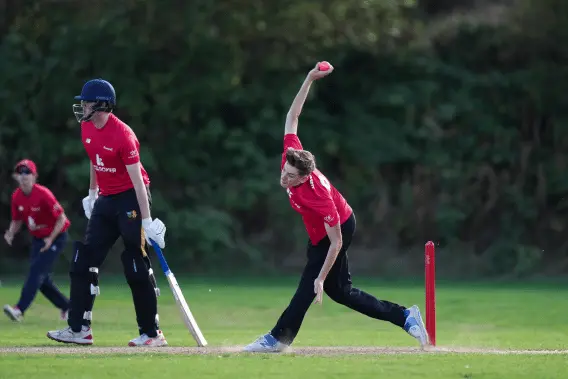
3 Fast Bowling Run Up mistakes slowing you down



If you want to bowl quicker, the run up is where most amateur fast bowlers leave their biggest speed on the table. Over the last six years working with hundreds of fast bowlers, three mistakes come up again and again. You are not running in a straight line. Your sprint mechanics are poor. And you are not running in with enough intent. Fix all three and you will bowl faster.
You may have heard these things before. The point of this article is not to teach you something brand new. It is to remind you why they actually matter, and give you the practical fixes to put them right this week.
Why the run up matters
The run up is your one chance to generate momentum before you deliver the ball. Everything that happens at back foot contact, front foot contact and release is built on top of what you did in the run up. A lot of fast bowlers analyse their action at the moment of front foot contact, spot that the front knee is not braced or that they are falling away at release, and then try to fix that specific thing. But the reason you are in a dodgy position at front foot contact is almost always because of what happened three or four strides earlier. Fix the cause, not the symptom.
Mistake one: not running in a straight line
If I asked you to move a ball from where you are standing to a cone 20 metres away as fast as possible, the answer is obvious. Straight line. So why do so many fast bowlers zigzag their run up, or start wide of the crease and then jump inwards at the last moment?
The problem is not that you cannot start from an angle. Plenty of pros run in on an angle to bowl wide of the crease or narrower to the stumps for a tactical reason. That is fine, and it is a pro-level thing. What I care about at amateur level is what happens in the last three or four strides.
The big jump inwards is the killer. If you land with your front foot crossing over your back foot, your momentum is now going across your body, not down the wicket. Your back foot tends to close off, which forces one of two ugly outcomes. Either you bowl it fine leg because your action is now pointing there, or you introduce huge amounts of lateral flexion and bend over to release it straight.
Whatever you can do to pick a line, run it, and stay on it into your jump, do it. Straight in, straight out.
Mistake two: poor sprint mechanics
The second mistake is treating your run up like it has nothing to do with sprinting. It has everything to do with sprinting.
There are two reasons this matters. The first is efficiency. If your mechanics are clean, you leak less energy, you feel less heavy and stuck in the mud as the spell goes on, and bowling gets easier. The second is top-end speed. You are probably running in at 80 to 90 per cent of your maximum sprint speed. If your top speed goes up, that 80 to 90 per cent shifts up too. Faster you at max means a faster you in the run up.
Sprinting is a skill. Like all skills, it can be trained. Here are the cues and drills I use with the fast bowlers I work with.
Stay tall
Stuart Broad talks about this a lot in his own career, and he is right. Sprint speed is stride length times stride frequency, and the taller you run, the longer your stride. The cue I use is imagining there is a piece of string on the top of your head pulling you up towards the ceiling.
The exercise to drill this in is an A march with a stump held overhead, arms straight. Imagine you have a bucket of water balanced on each side and you are trying not to spill either as you march. Keep the stump level and keep the trunk still. It looks simple but a lot of bowlers leak sideways as soon as they add speed, and this shows it up straight away.
Push the ground away
The second cue is what should be happening when your foot is on the ground. Sprinting is horizontal projection, not vertical. You want to feel like you are pushing the ground away behind you with every stride, leaving footprints in the pitch, rather than jumping upwards with your knees.
The exercise for this is a wall march. Lean forward at around 45 degrees against a wall, hold the position, and push one foot into the floor as hard as you can while the other drives up. Nice straight back leg, imagine leaving a footprint. This teaches your legs what pushing the ground away actually feels like.
Mistake three: no intent
The third mistake I see everywhere at amateur level is not running in with proper intent. Amateur fast bowlers think about their field, they think about the batter, they think about their release. All fine. But if the body is not being asked to move at speed, the body will not move at speed.
Watch Sonny Baker run in. He absolutely charges. Every ball, 100 per cent. That is not a coincidence. If you do that for a few years in a row, the body learns to move at that speed, in the same way the body learns to lift heavier if you push effort in the gym.
The simplest way to add intent to your training is this. Once a week, after a proper warm up and a few run-throughs at 50 and 75 per cent, bowl three to six balls at 100 per cent. Actually try to bowl as fast as you can. Then move into your normal skill work.
Here is why this matters. The best power exercise for a fast bowler is trying to bowl as fast as they can. Same way the best power exercise for a power hitter is trying to hit the ball as hard as they can. The gym gives you the physical tools to do it faster and more reliably without breaking down. But the pattern itself has to be trained at real speed. If you never ask your body to move at top pace, it will never magically get faster.
How to actually put it into practice
Fix these in order. First, watch a video of your run up and check the line. Straight in, straight out. If it zigzags or jumps inwards, sort that first, because everything downstream depends on it.
Second, add the sprint drills to your bowling warm up. Watch the video below for these.
Third, put three to six balls of pure intent into one net session a week. Not the whole spell, just a short block. That is the piece that turns better mechanics into more actual speed on the ball.
Where Cricfit fits in
Cricfit fast bowling programmes are built around this exact idea. Sprint mechanics, strength through the lower body and trunk, power and rate of force development, and workload management to keep you fit while you are asking the body to move faster. Bowlers like Noah, who added seven miles per hour over a single winter, and Angus, who we brought back from a stress fracture, are examples of what the physical work looks like when it is layered on top of good run up mechanics.