


Fast Bowling Warm Up


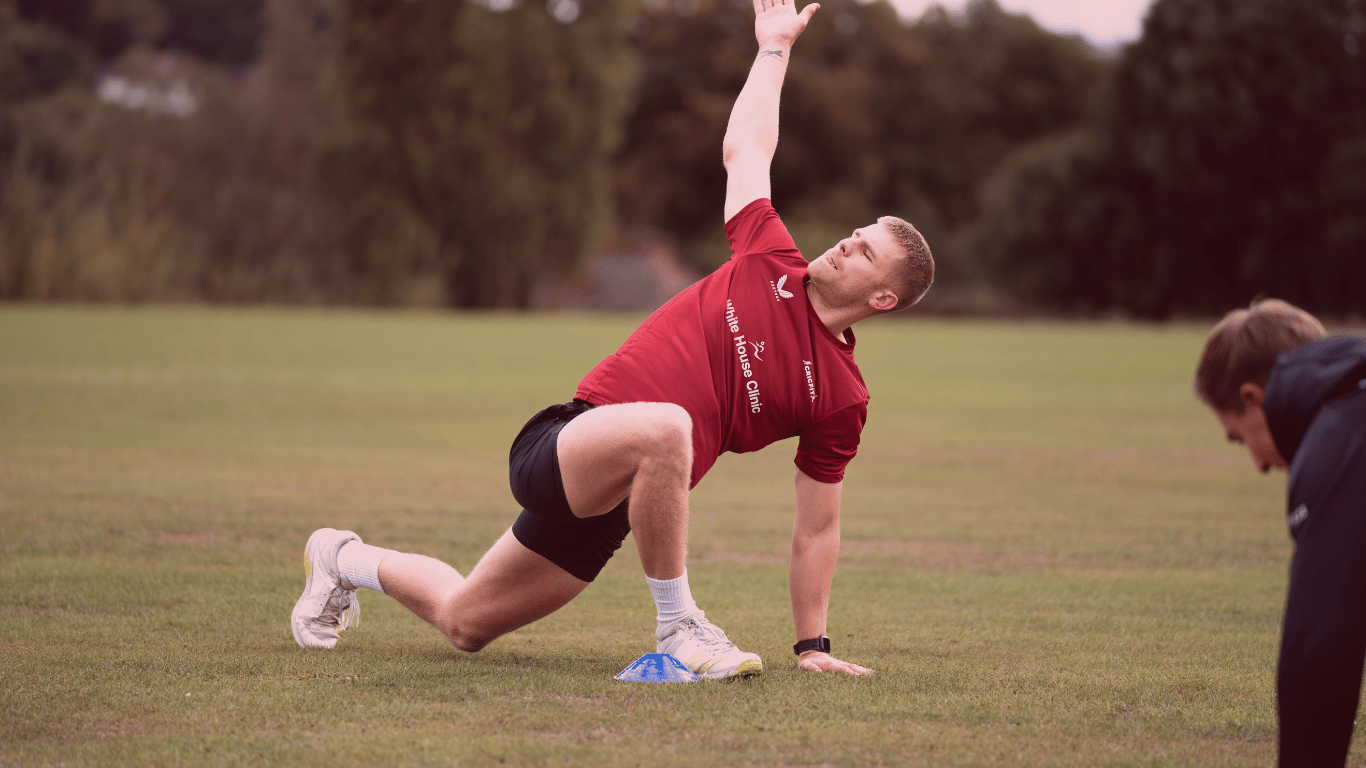
If you bowl fast, your warm up needs to hit four things. Raise your body temperature, mobilise the joints you use to bowl, activate the muscles that drive the action, and switch on your nervous system so you can move quickly from ball one. Everything else is a variation on those four points. In this guide I will walk you through the framework, then give you two routines that use it. A longer one for when you have time before a game, and a two minute version for when your captain gives you the signal at fine leg and you need to warm up on the fly.
The RAMP protocol
RAMP stands for raise, activate, mobilise and potentiate. It has been the standard warm up framework in strength and conditioning for years, since Jeffreys (2006) put it together, and it works because it takes you from cold to ready in a logical order.
Raise means lifting your body temperature and heart rate. Most people take this to mean go for a lap around the boundary before anything else, but I would push back on that. Your body is not ready to run a lap when it has just come out of the car. The raise happens as a byproduct of the next three sections anyway, so you do not need to force it up front.
Activate is about firing up the key muscle groups. For a fast bowler that means calves, quads, hamstrings, glutes, the core to a point, and everything around the shoulder.
Mobilise is about moving the key joints through range. Ankles, knees, hips, the thoracic spine, which is your upper back, and the shoulders.
Potentiate is the one most people forget. It means switching your nervous system on so you can move fast. The way I explain it is this. If you get out of the car feeling groggy and I throw a ball at you, it hits you in the face. After a proper warm up, you should feel like Spider-Man. Sharp, reactive, ready.
Whether you have 30 minutes or 3 minutes, you can tick all four boxes. The routines below just do it in different levels of detail.
The full warm up before a game
This is what I would run through when you have proper time before a game or in the hour build up. Spend around 10 to 20 minutes on it depending on the day. Six to ten reps of each exercise if you are on the tighter end, ten to twenty if you have more time. Think of it like a slightly harder yoga class that ends in a sprint.
Mobility block
Child's pose
Sit back on your heels and reach the arms forward as far as you can. Breathe in through the nose and out through the mouth for longer than you breathed in. Reach round to the left and the right to open up the sides. This releases the tension we all carry through the shoulders and upper back.
Pigeon with rotation
Start on all fours and bring one shin flat under you. You should feel a stretch through the outside of the back hip. From there, take the same side hand under and rotate up and round through the upper back. Two things at once, hip and thoracic mobility.
Kneeling hip flexor rocks
Come up to a tall kneeling position. Imagine you are tucking your tailbone forwards underneath you, then squeeze the back glute hard to open the front of the hip. Rock forward and back to work the stretch, then take it 45 degrees and 90 degrees round to get every angle.
Hamstring kicks
Lie on your back. Grab the back of one thigh, kick the leg out until it is straight and hold for a second, then bend back in. Do not rush it. Feel the stretch through the hamstring rather than just cycling the leg.
Half eagle
Side lying, top arm out flat, top knee bent up to waist height. Lock the knee to the floor so the hips cannot move, then take the top hand behind the head and try to open the top elbow towards the floor behind you. This creates hip and shoulder separation without letting the hips cheat, which is exactly what you need when you rotate to bowl.
Floor slides
On your back, arms in a W position on the floor, low back pressed down, and slide the arms overhead and back. If you struggle to keep the low back down, you are compensating through the spine, which is what limits your shoulder when you go to bowl.
Activation block
Split stance calf raises
Step one foot out in front of the other, raise the front heel off the floor, and control it back down. The calf is what stops the back leg collapsing at back foot contact, so 30 to 60 seconds a side to get a little burn on is what you are after.
Glute bridges
Both feet on the floor, drive the hips up, squeeze the glutes at the top, and control back down. Do a set with both feet, then progress to single leg bridges, then a marching version where you alternate.
Hamstring walkouts
Same starting position as the glute bridge, but walk the feet out further so the load moves down the chain from glute to hamstring. Finish with walkouts through full range. Same rule of thumb, 30 to 60 seconds until they are warm and awake.
Prone I-W-Y-T
Face down on the floor, cycle through prone raises. Arms in a W, up into an I overhead, back to a W, out to a Y, back to a W, out to a T. Slow and controlled, keeping the chest on the floor.
Prone external rotations
Elbow level with the shoulder, chest still on the floor, forearm hanging down. Lift the back of the hand towards the ceiling. Most people cannot get their forearm all the way off the floor, and most people cheat by hinging at the wrist rather than rotating at the shoulder. Get this right and you wake up all the small muscles that get injured in bowlers who skip their shoulder work.
Shoulder isometrics
If you have a net or a sight screen nearby, tuck the elbow into the ribs and push into the net as hard as you can straight ahead. Then push outwards. Then push overhead. Five to ten seconds each. That fires up the pecs and the whole shoulder complex ready to hit top speeds.
Potentiation block
Hops, skips and pogos
Hop and skip on the spot for a bit to get sharp. Progress to pogos, jumping in place with the shortest possible ground contact, focusing on ankle stiffness and quick feet.
Sprint build up
Start with a gentle jog. Then some strides at around 50 per cent. A bit of rest. Then 75 per cent strides. A bit more rest. Then two 20 metre sprints at full pace with proper recovery between them. That is enough. Any more and you leave your best work on the outfield.
Now you are breathing heavy, warm, mobile, activated, sharp, and ready to bowl. The last piece, and it matters, is the actual bowling. Build into your run up gradually. Do not walk from your last sprint straight into a full 15 stride run up at match pace.
The two minute warm up at fine leg
This is the one for when your captain gives you the signal and you have no time to run through the full routine. The rule here is high bang for buck. Every exercise should tick more than one RAMP box.
Spider-man plank
Plank position, step one foot up outside the same side hand, dip the hip down, rotate the top arm up towards the sky, come back and alternate. Hip mobility, thoracic rotation, shoulder mobility and core activation, all in one.
Full eagle
Lie flat on your back in a cross position, then take one leg up and across towards the opposite hand. Alternate sides. Adds hip and lower back mobility with a bit of rotation.
Frame taps
From a plank, tap the opposite hand to the opposite toe under the body. Shoulder stability and a bit of core rotation in one move.
Cobra
Prone, hands under the shoulders, press the chest off the floor and open through the spine. Opens up the front of the hips and the thoracic spine and stretches the shoulders through range.
Potentiation burst
A few A skips, a few A switches, one kick out and drag under drill, then a set of pogos. Thirty seconds. Bang. You have ticked all four RAMP boxes in under two minutes. Now walk to your mark, bowl your first over at 90 per cent, not 100 per cent, and you give yourself the best chance of the second over being your fastest.
Are med ball slams overrated for fast bowlers?
A quick word on the exercise you see every fast bowler on TV do in their warm up. Med ball slams, rotational or overhead. My honest answer is that for a professional, they are brilliant. For an amateur, especially a junior, they are often overrated and occasionally risky.
The reason they work for a pro is that they are not doing them for the first time on the boundary. They are doing them as part of a gym programme focused on rate of force development and upper body speed. They know how to sequence the throw. They know their loading tolerances. The slams are a warm up bridge from their strength training to their bowling action.
For a junior, slamming a med ball heavier than about three kilograms without the training background to support it is more risk than reward. If you have never done a med ball throw in the gym, do not add one on the boundary because it looks the part. You are better off with the two minute routine above, which does more for you and does not need a heavy ball.
If you do train med ball work regularly and you know your positions, add a couple of rotational slams at the end of your potentiation block. Otherwise skip it.
The take home
Every fast bowler warm up needs to raise, activate, mobilise and potentiate. If you have time, spend 15 minutes on the full routine and finish with sprints. If you have two minutes, use the high value exercises that hit multiple RAMP boxes at once. Either way, finish by building into your bowling rather than jumping straight to full pace.
If you want the physical side of your bowling handled from top to bottom, not just your warm up but the strength, power, mobility and durability behind it, that is what Cricfit programmes are built for. The specialist fast bowler programme covers the gym work that makes both of these warm ups possible in the first place.
Reference
Jeffreys, I. (2006). Warm up revisited: The 'ramp' method of optimising performance preparation. Professional Strength and Conditioning, 6, 15-19.


