


Fast Bowling Workload: The ECB Guidelines, the research and what it really means for you


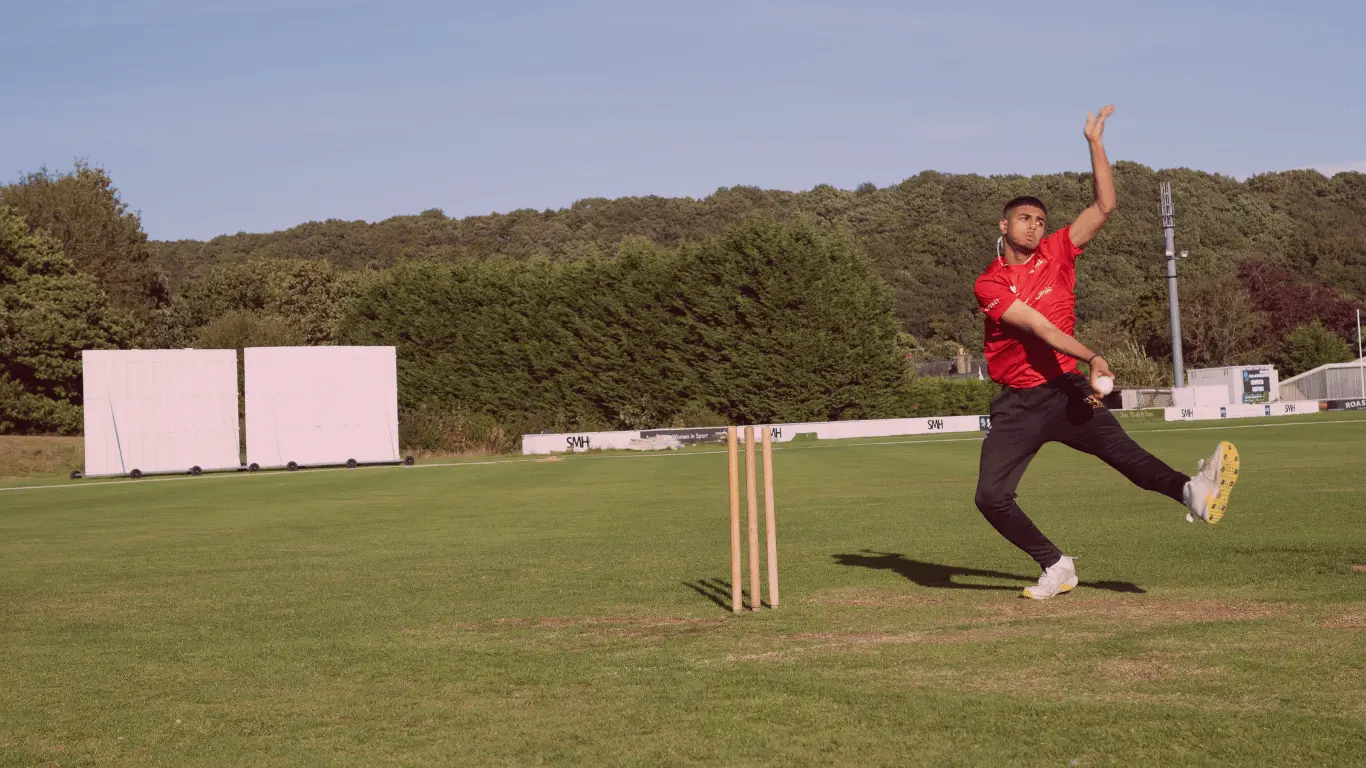
If you bowl fast, the single most important thing you can do to stay fit is manage your workload. The ECB guidelines are clear.
In any seven day period you should bowl no more than four days, with only one block of bowling on back to back days.
You should stay inside a target overs range for your age. And when you go over that target, you should give your body time to repair. That is the headline. This article is the long version.
There are a lot of voices in the fast bowling workload conversation. You have the ECB on one side, the "back in my day" crew on the other, and somewhere in the middle you have captains, coaches, parents, teammates and umpires all pulling you in different directions. The aim of this guide is to cut through the noise. We will walk through what the ECB rules actually say, look at the research that sits behind them, and finish with what I think is the most practical way to apply all of it as an amateur or junior cricketer.
Why fast bowling is so hard on the body
Before we go near the numbers, you need to understand why workload matters. Fast bowling is one of the highest demand actions in sport. You are loading your body at speed, you are doing it with one arm so the forces are uneven, and to keep that bowling arm straight you have to twist into ugly positions through the hips, spine and shoulders. Then you do it thousands of times a year, as fast as you can. It is not just running. It is not just throwing. It is its own thing, and the body has to be ready for it. Workload is how we manage that demand.
The ECB fast bowling workload guidelines
The ECB publishes the official rules for fast bowlers in the UK, and they have been updated several times over the last few years. The most recent versions come from 2024 and 2025 (England and Wales Cricket Board, 2024, 2025a, 2025b). Most coaches and parents have heard of bits of them. Far fewer have read the lot. Here is the full picture.
Four days bowling in a seven day period
The most well known rule was shared in 2020 and said that in any seven day period a bowler should not bowl more than four days in total, with no more than two days in a row (England and Wales Cricket Board, 2020). In the 2024 update the wording was tightened (England and Wales Cricket Board, 2024). It now says a maximum of four days bowling in any seven day period, with only one instance of bowling on consecutive days. The change matters. Under the 2020 rule you could technically bowl Monday and Tuesday, then again Saturday and Sunday. Under the 2024 rule, if you have already bowled on back to back days that week, you need to put a rest day between any further bowling days.
For an adult club cricketer, four bowling days in seven is realistic. For a junior playing for school, club, district and county in the same week, it is much harder. I am not telling you to break the rule. It is there for a reason. I am being honest that for younger players you will sometimes have to turn down games to follow it, and that is where this whole topic gets tough.
Maximum overs per spell and per day
The 2025 directive added clear in-match limits on how many overs you can bowl in one spell and across a whole day (England and Wales Cricket Board, 2025a). The older you are, the higher both numbers go.
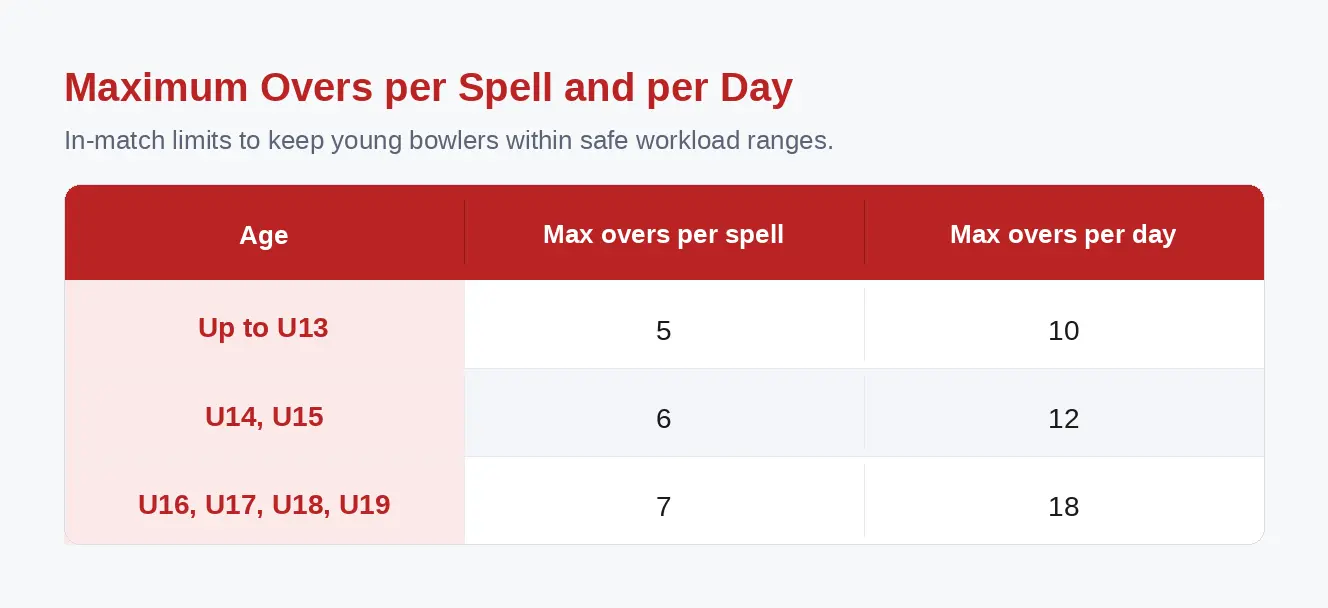
These are sensible numbers, but remember they are based on age, not on size or maturity. A 13 year old can be every bit as physically developed as a 16 year old, and the other way round. Use the numbers as a guide, not as gospel.
Target overs per week
The 2024 guidance gives a target weekly overs range for each age group (England and Wales Cricket Board, 2024). This is where most people start, because it is the easiest number to picture.
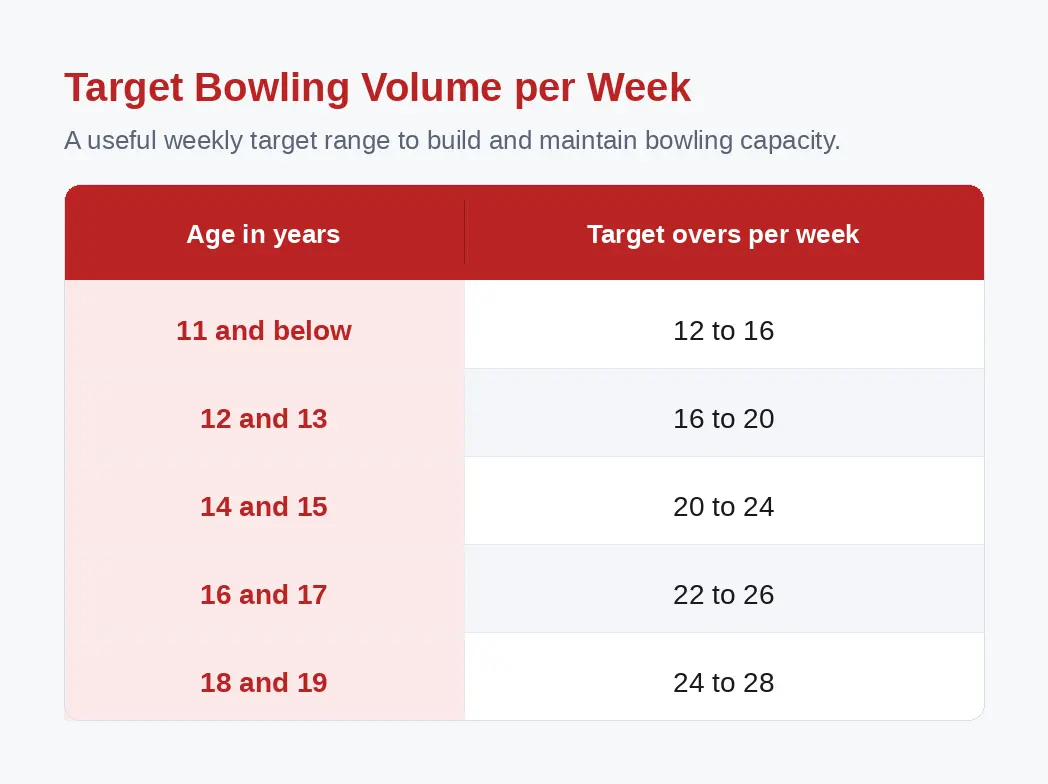
A 15 year old looking at this table will see 20 to 24 overs and think, "I can bowl five overs across four matches a week." That is true in match terms. But here is the bit most people miss. The ECB also notes that a delivery should be counted as any ball delivered in matches and any ball bowled in training with the intent of bowling at match or near match intensity. So your warm up balls count if you are running in hard. Net sessions count. Bowling for a different team midweek counts. In the off season, when you might be in three or four net sessions a week being used as a bowling machine, your total weekly volume can rocket without you noticing. That is the grey area where a lot of young bowlers get caught out.
What to do when you go over your workload, and how to come back
Two more tables sit underneath all of this. The first deals with what happens when you breach the target weekly overs. The second deals with how to return to bowling after time off.
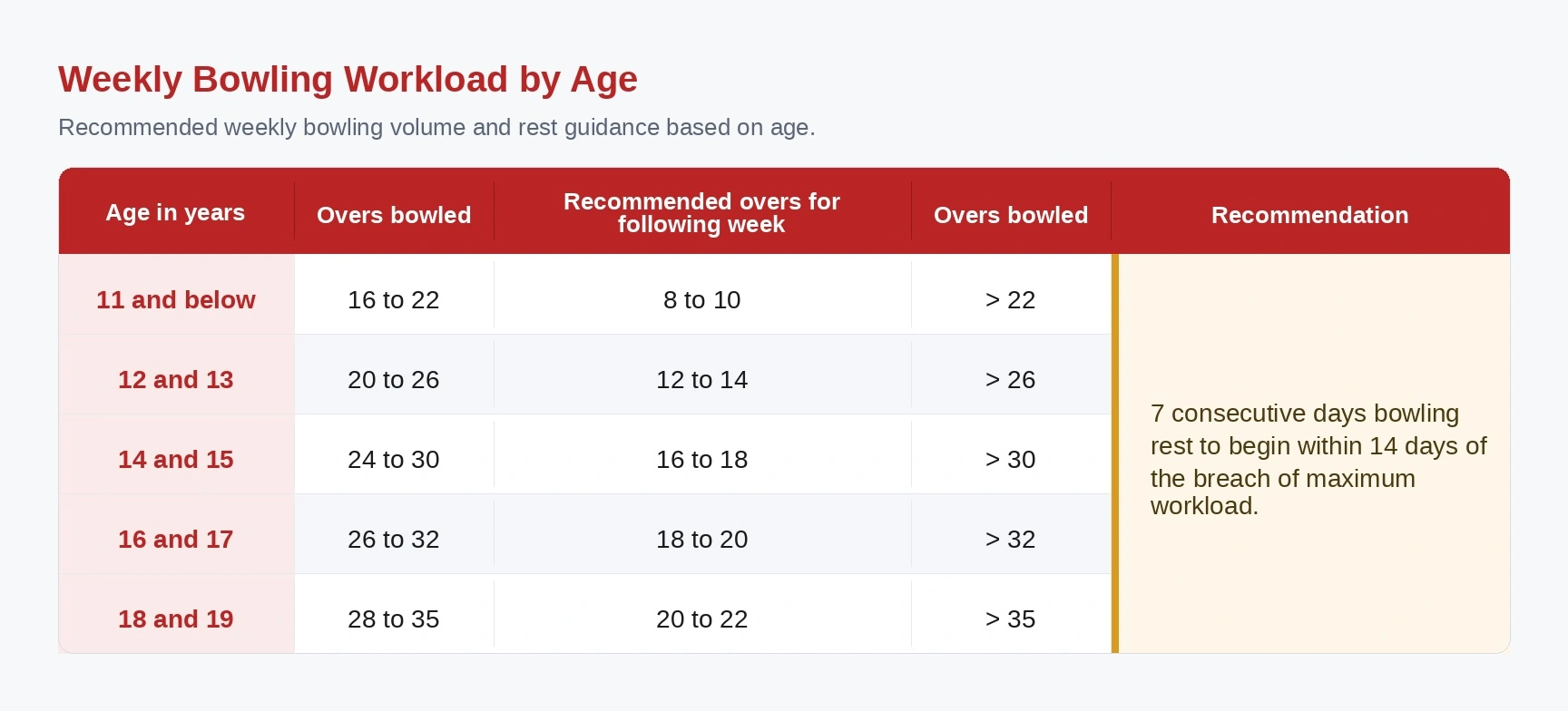
If you bowl above the upper number in your age group, the ECB recommends seven days of bowling rest, starting within 14 days of the spike. It is a forced deload to give your body time to repair. There is also a recommendation to take a seven to ten day break from bowling somewhere in the middle of the season. I am not the guy who will tell a 15 year old in flying form in August to put the ball down for a week, but I do understand why it is in there.
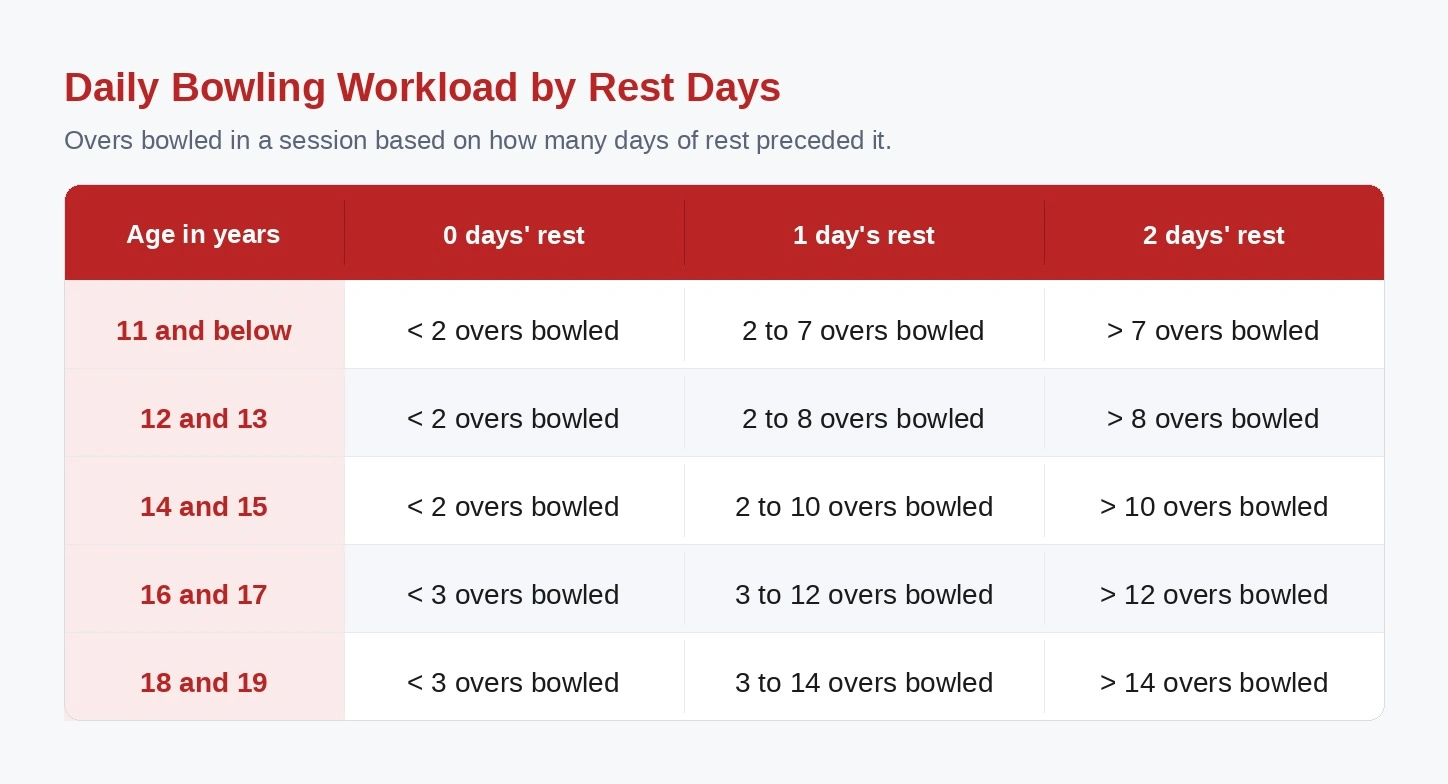
The second table works the other way. After time off, the more days of rest you have had, the more overs you are allowed to bowl when you come back. This is gold dust after a two week summer holiday, or, as we will come on to, after a rain break.
What actually counts as a delivery
This is worth saying twice, because it is the bit that costs young bowlers most often. A delivery is not just a match ball. If you are bowling at match intensity in a net, in a warm up, those balls count too. If you play for three sides and bowl in the warm up for each, your total real workload is well above what the scorebook says. Track every ball you bowl with proper effort, not just the ones the scorer writes down. If you are not doing that, you are flying blind.
The acute to chronic workload ratio
A second tool you may come across for monitoring workload is the acute to chronic workload ratio, often shortened to ACWR. It is a ratio between two numbers. Your acute workload is the total bowling you have done in the past seven days, sometimes thought of as your fatigue. Your chronic workload is the average weekly bowling over the past 28 days, sometimes thought of as your fitness.
If your acute workload is well above your chronic workload, you have spiked. Most of the early research, including a key paper by Hulin et al. (2014) on elite cricket fast bowlers, found that big spikes are linked to a higher risk of injury. As a rough rule of thumb, an ACWR above 1.5 is the point where risk starts to climb. So if you average ten overs a week and then bowl 15 overs in one week, you have spiked, and your risk goes up.
There is a less obvious side to ACWR which is the protective effect of a high chronic workload. If you build your weekly bowling up steadily over time, the body adapts. The danger is in the sudden jumps, not in the level itself, within reason. The model has been challenged in more recent work, including by Impellizzeri et al. (2020), who argued there is not enough evidence to use ACWR as a stand alone training management tool. They point out the maths behind the ratio is flawed and the causal link to injury is not properly established. So treat ACWR as one useful lens, not as the answer.
What the research actually says
The research that sits behind all these guidelines is mostly built around stress fractures, because they are the most common serious injury in fast bowling. They are also one of the worst to recover from, because they are largely silent until they are not. You can have a stress fracture right now and not know it.
How common are stress fractures in fast bowlers? More common than you would think. Keylock et al. (2022) scanned 40 adolescent fast bowlers and found that around half had a lumbar bone stress injury at baseline, even though the players were not in pain. Other prevalence figures sit lower, depending on whether researchers are counting reported injuries or scan findings, but the message is the same. Stress injuries are out there even in bowlers who feel fine.
The piece of research that has shaped the modern workload guidelines more than any other is Alway et al. (2019). They tracked 368 English county fast bowlers across the first and second team from 2010 to 2016 and recorded 57 lumbar stress fractures. They then compared injured bowlers to a matched group of uninjured ones and looked at their bowling workload before injury. The headline finding was clear.
Bowlers who bowled more than 234 balls in a seven day window, which is 39 overs, had a sharply higher chance of getting injured than those who bowled less.
Across acute (seven day), monthly (28 day) and three monthly (90 day) windows, injured bowlers had been doing significantly more work.
Two things matter about that number. First, those were professionals, training full time and well conditioned. If 39 overs is the danger point for them, it is going to be lower for an amateur or junior. Second, not every bowler who went above 234 balls got hurt. The bowlers who stayed fit after a heavy week tended to have around 44 per cent more rest in the days that followed. That is exactly why you see professional teams rotate bowlers between games.
The final piece worth knowing is timing. There is typically a three to six week delay between the spike in workload and the stress fracture showing up. That is what makes these injuries so frustrating. The damaging week of bowling can feel fine. The pain shows up a month later, by which point the cause has already moved out of sight.
The rain problem
There is one part of the workload story that is hard to capture in a study, and it is one of the biggest issues in UK cricket. Rain. When the weather wipes out two weeks of fixtures in June or July, every bowler in the country goes from a steady workload to zero. Then play resumes and the workload spikes straight back up to full match volume in the first weekend. Add in the three to six week injury delay and you get the late summer wave of bowlers breaking down that most clubs see every season.
You cannot control the weather. You can control what you do during the rain weeks. If you can get out on dry days and bowl a handful of overs at intensity to keep your chronic workload ticking over, you will protect yourself when the matches restart. Most people will not do this. The ones who do are the ones who tend to stay fit through August and September.
The bowler at the centre
Workload matters. But on its own it will not keep you fit. Picture three legs of a stool. The first is your workload, which is what we have spent this article on. The second is your physical fitness, your strength, your speed and how well you hold up under load in the gym. The third is your bowling technique. If any one of those three is missing, the stool falls over. You can have a clean weekly workload and still get injured if you are weak or if your action puts huge stress through the lumbar spine. You can be strong and have a great action and still get injured if you spike your bowling volume.
The bowler in the middle of the stool is you. Your coaches, captains, parents and teammates are there to support, but the responsibility for staying fit lives with you. Any coach who tells you they can fully guarantee you will not get injured is selling you something. What we can do is stack the odds in your favour. Manage the workload. Build the body. Tidy the action. Repeat.
A simple way to track your workload
If all of this feels like a lot, here is the version I give to the bowlers I work with. Track every ball you bowl at intensity, in matches and in training. Try to keep your weekly bowling within plus or minus ten per cent of the previous week. So if you bowled 100 balls last week, you are looking at 90 to 110 balls this week.
Do that consistently for a few months and two things happen. Your chronic workload climbs steadily, which gives you the protective effect we talked about earlier. And your acute to chronic ratio stays inside the safe zone. From there you can work up to the ECB target ranges and back away from them without spiking. That is how you stay on the pitch.
Where Cricfit fits in
Cricfit programmes are built to give you the fitness leg of the stool. Strength, power, speed and durability, built around what fast bowlers actually do on a cricket pitch. If you pair that with sensible workload tracking and a good bowling coach, you give yourself the best possible shot at staying fit and bowling fast.
If you have any questions about anything in this guide, or there is research I have not covered, get in touch.
References
Alway, P., Brooke-Wavell, K., Langley, B., King, M., & Peirce, N. (2019). Incidence and prevalence of lumbar stress fracture in English County Cricket fast bowlers, association with bowling workload and seasonal variation. BMJ Open Sport & Exercise Medicine, 5(1), e000529.
England and Wales Cricket Board. (2020). 2020 Fast Bowling Directives.
England and Wales Cricket Board. (2024). Recreational Fast Bowling Guidance 2024.
England and Wales Cricket Board. (2025a). Fast Bowling Regulations for players aged 19 and below.
England and Wales Cricket Board. (2025b). Recreational Cricket Safety Regulations.
Hulin, B. T., Gabbett, T. J., Blanch, P., Chapman, P., Bailey, D., & Orchard, J. W. (2014). Spikes in acute workload are associated with increased injury risk in elite cricket fast bowlers. British Journal of Sports Medicine, 48(8), 708-712.
Impellizzeri, F. M., Tenan, M. S., Kempton, T., Novak, A., & Coutts, A. J. (2020). Acute:Chronic Workload Ratio: Conceptual issues and fundamental pitfalls. International Journal of Sports Physiology and Performance, 15(6), 907-913.
Keylock, L., Alway, P., Felton, P., McCaig, S., Brooke-Wavell, K., King, M., & Peirce, N. (2022). Lumbar bone stress injuries and risk factors in adolescent cricket fast bowlers. Journal of Sports Sciences.


